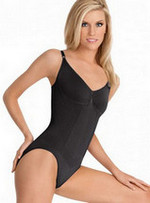
Explaining where corsets originated from, what materials they've been comprised of, and the changes they've affected in fashion.
The corset, an article of clothing worn to shape or restrict the torso, whether as underclothing or as outer decoration. A garment of great antiquity, the corset goes back at least to the 2nd millennium BC, when it was worn by Cretans of the Minoan Bronze Age. Minoan women wore them as an outer garment to cinch the waist and raise the breasts; they were worn as well by Minoan men, who appeared wasp-waisted in consequence.
The guepiere, or waspie, as a modern day underclothing
for cinching the waist, is only one form the female corset has taken;
it has varied with the changing concepts of the ideal figure. Between
1550 and 1660, corsets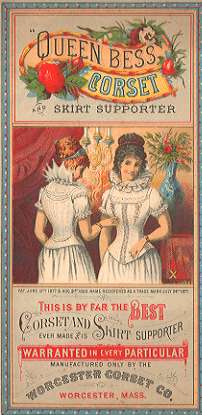 had the purpose of flattening the upper part of the body, including
the breasts; they were reinforced by busks, made generally of wood.
The much-embroidered and sometimes jewelled stomacher was a kind of
outer corset. After 1660 the corset became shorter and was so shaped
as to support and accentuate the breasts. It went out of fashion briefly
after the French Revolution during the ascendancy of Directory and Empire
fashions, which were Grecian, diaphanous, and body-clinging; but it
turned about 1810 and changed throughout the 19th century with the ever-changing
shape of dresses. By that time, corsets were reinforced with whalebone
and metal.
had the purpose of flattening the upper part of the body, including
the breasts; they were reinforced by busks, made generally of wood.
The much-embroidered and sometimes jewelled stomacher was a kind of
outer corset. After 1660 the corset became shorter and was so shaped
as to support and accentuate the breasts. It went out of fashion briefly
after the French Revolution during the ascendancy of Directory and Empire
fashions, which were Grecian, diaphanous, and body-clinging; but it
turned about 1810 and changed throughout the 19th century with the ever-changing
shape of dresses. By that time, corsets were reinforced with whalebone
and metal.
Although polemics against tight corsets are common in literature from the late 17th century onward, no one seriously tried to abolish them until 1908, when clothes with fluid lines began to be designed to be worn without corsets. As early as about 1870, women in the artistic coterie promoting Aestheticism wore dresses with an uncorseted look. Neither of those designs became high fashion, however, and corsets continued to be worn until the 1920s, with the advent of straight, unwaisted clothes. In the late 1930s there was an attempt by designers to bring back the boned corset, but World Was II cut short most stylish innovations.
The corset was greatly modified at the beginning of the 20th century: it was shorter and no longer supported the breasts, leading to the invention of the brassiere (c. 1912 by a Paris couturiere, Madame Cadolle). That garment and the Cavalieri maillot (a topless corset made of elastic material, c. 1913) were the prototypes of the brassiere and girdle (in England called the belt) of the 1930s. The main innovations (especially since the 1960s) incorporated improved synthetic-elastic materials. The corselets, a one-piece garment combining brassiere and girdle, was developed in the 1930s and is still worn.
To our valued customers
 New
lingerie, clothing and accessory items are coming in regularly. If you
want to be among the 1st to look at all the latest additions or if you
want to be among the 1st so grab the best sale items join our
newsletter and we'll keep you updated.
New
lingerie, clothing and accessory items are coming in regularly. If you
want to be among the 1st to look at all the latest additions or if you
want to be among the 1st so grab the best sale items join our
newsletter and we'll keep you updated.
We value your Privacy